
Views: 0 Author: Site Editor Publish Time: 2026-08-07 Origin: Site


Wheelchair Handcycle vs Power Wheelchair: Which One Fits Your Life Better?
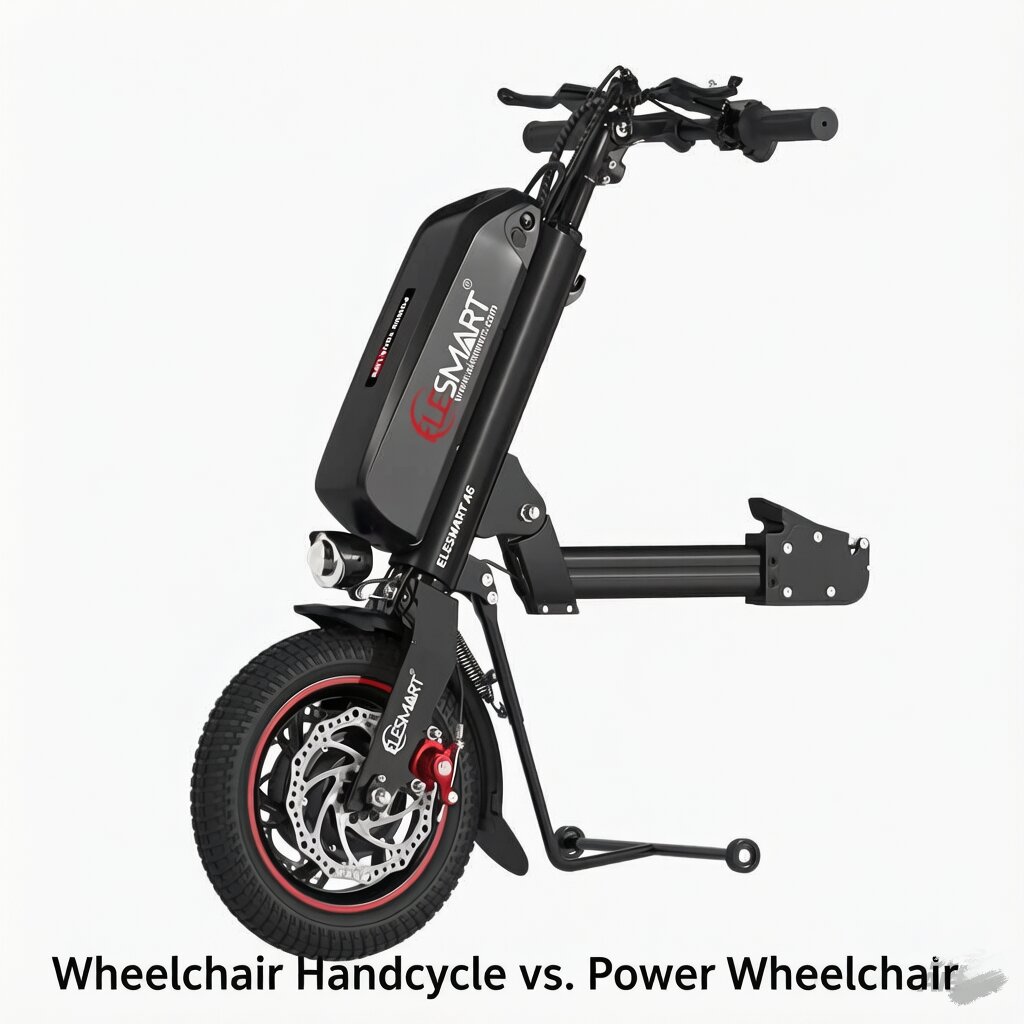
When it comes to electric mobility, the choices can feel overwhelming. Two of the most common options for people with limited lower‑body function are the power wheelchair and the wheelchair handcycle. Although both provide motorised assistance, they are fundamentally different in design, purpose, and daily usability. Making the right decision isn’t just about technical specs—it’s about how you want to live, move, and interact with the world around you.
Understanding the core differences between a wheelchair handcycle and a power wheelchair is the first step toward choosing a solution that genuinely enhances your independence.
What Is a Power Wheelchair?
A power wheelchair is a complete, self‑propelled mobility device. It consists of a frame, one or two motors, a battery pack, and a control system—usually a joystick—all integrated into one unit. The user sits in the chair, and the entire vehicle moves under electric power. Power wheelchairs are available in rear‑wheel, mid‑wheel, and front‑wheel drive configurations, each offering specific handling characteristics.
These chairs are designed for people who need full‑time motorised support. They provide excellent stability, advanced seating options (such as tilt, recline, and leg rests), and are particularly well‑suited for indoor environments like homes, hospitals, and shopping centres. Many models are also capable of outdoor use, especially those with larger wheels and higher ground clearance.
However, power wheelchairs are heavy—often exceeding 100 kg—and expensive. They require regular maintenance, and transporting them usually demands a adapted vehicle with a ramp or lift. Their size can also be a drawback in narrow corridors or crowded spaces.
What Is a Wheelchair Handcycle?
A wheelchair handcycle is an attachable front unit that connects to a manual wheelchair. It typically includes a front wheel, handlebars with brakes and throttle controls, a motor, and a battery. When attached, it lifts the wheelchair’s front castors off the ground, creating a stable three‑wheeled vehicle. The user steers and accelerates using the handlebars, much like riding a bicycle, but powered by an electric motor.
Crucially, a handcycle does not replace your manual wheelchair. It is an accessory that you can attach or detach in seconds. This means you keep your custom‑fitted, lightweight manual chair for indoor use, and simply add the handcycle when you want to venture outdoors. This modular approach offers unparalleled flexibility.
Handcycles are specifically engineered for outdoor mobility. They excel on uneven pavements, gravel paths, slopes, and even light off‑road trails. With powerful motors (often 250W to 1000W) and long‑range batteries, they allow users to travel distances of 40–60 km on a single charge, at speeds up to 25 km/h. They are also considerably lighter than power wheelchairs—most weigh between 10 and 16 kg, making them easy to detach and load into a car.
Head‑to‑Head Comparison
1. Integration and Versatility
The most obvious difference is that a power wheelchair is a single, permanent device; a handcycle is an add‑on. With a handcycle, you have two mobility tools in one: your manual wheelchair for indoor navigation, and the handcycle for outdoor expeditions. This dual functionality is especially valuable if you frequently switch between tight indoor spaces and open outdoor environments. A power wheelchair, by contrast, is your sole vehicle—you cannot easily detach its motor or reduce its footprint.
2. Indoor Performance
Indoors, a manual wheelchair (without the handcycle) is far more manoeuvrable than any power wheelchair. It is lighter, narrower, and can turn in tighter circles. You can easily move around a dining table, enter a small lift, or navigate a narrow bathroom doorway. Power wheelchairs, even the most compact models, are bulkier and can damage walls or furniture if space is limited.
3. Outdoor Capability
Outdoors, the handcycle is the clear winner for most users. Its large front wheel, suspension (on many models), and ergonomic handlebars provide a smooth, stable ride over bumps and cracks. The electric assist makes climbing hills effortless. Some handcycles even feature cruise control and regenerative braking for added safety and comfort. Power wheelchairs can handle some outdoor terrain, but they are generally slower, less agile on rough ground, and more likely to get stuck on soft surfaces like grass or gravel.
4. Control and Ease of Use
Power wheelchairs are typically controlled by a joystick, which requires fine finger and wrist movements. This can be challenging for individuals with limited hand dexterity or neurological conditions. Handcycles use handlebar controls—twist‑grip throttles, push‑button acceleration, or lever brakes—that rely on gross arm and hand movements. Many users find this more intuitive, especially if they previously rode bicycles or motorcycles. Some handcycles even offer quad‑friendly controls that require minimal hand strength.
5. Weight and Transport
Here the handcycle has a huge advantage. Because it is separate from the wheelchair, you can detach it and load each piece individually. The handcycle itself weighs around 12–15 kg, while the manual wheelchair may weigh 10–15 kg. Together they are still lighter than most power wheelchairs, and you can often fit them into a standard car boot. Power wheelchairs, weighing 80–120 kg or more, typically require a specialised vehicle with a hoist or ramp, limiting travel options and increasing costs.
6. Cost and Value
Power wheelchairs are a significant investment, often costing several thousand dollars. For many users, this is a barrier to access. Handcycles are much more affordable—entry‑level models start around €800–€1,000, and even high‑end versions are considerably cheaper than a new power wheelchair. Moreover, if you already own a manual wheelchair, you avoid the expense of replacing an entire mobility system. This makes handcycles a cost‑effective way to gain electric mobility without breaking the bank.
7. Health and Activity Level
This is a subtle but crucial factor. Power wheelchairs require almost no physical exertion, which can lead to muscle deconditioning, reduced cardiovascular fitness, and increased risk of pressure sores over time. A handcycle, even with electric assistance, still encourages upper‑body movement—steering, braking, and occasionally pedalling (in hybrid models). Studies have shown that handcycling improves shoulder strength, reduces fatigue from manual propulsion, and enhances overall well‑being. For users who want to stay active while extending their range, a handcycle offers a healthy balance.
Who Should Choose a Power Wheelchair?
A power wheelchair is the right choice if:
You require constant postural support, such as tilt‑in‑space or reclining backrests.
You have very limited upper‑body strength or coordination.
You spend most of your time indoors and need a stable, always‑ready seat.
You do not own a manual wheelchair or prefer not to transfer between devices.
Who Should Choose a Wheelchair Handcycle?
A handcycle is ideal if:
You already have a manual wheelchair that fits you perfectly.
You want the flexibility to go electric only when needed.
You love outdoor activities—travelling, sightseeing, or simply exploring your neighbourhood.
You need a portable, easy‑to‑transport solution.
You are budget‑conscious and want to avoid the high cost of a power wheelchair.
Real‑Life Scenarios
Imagine you live in an apartment with narrow hallways. A power wheelchair might be too large to turn comfortably, but a manual wheelchair with a detachable handcycle lets you move freely inside. When you want to visit the park, you attach the handcycle in seconds and ride for miles without exhaustion.
Or consider a frequent traveller. With a handcycle, you can fly with your lightweight manual chair, pack the handcycle in a travel bag, and reassemble at your destination. A power wheelchair would require cumbersome shipping and special handling.
Making Your Decision
There is no one‑size‑fits‑all answer. The best choice depends on your physical abilities, daily routines, living space, and personal preferences. A power wheelchair offers simplicity and all‑in‑one convenience, but at the cost of weight, price, and indoor manoeuvrability. A wheelchair handcycle gives you versatility, portability, and affordability, while encouraging an active lifestyle.
Why ELESMART Stands Out
At ELESMART, we believe that mobility should be empowering, not limiting. Our range of electric handcycles is designed to transform your manual wheelchair into a powerful outdoor companion. With features like high‑torque motors, long‑life lithium batteries, adjustable handlebars, and intuitive controls, our handcycles are built for comfort, safety, and performance. They attach to almost any standard manual wheelchair and can be removed in moments, giving you the freedom to switch between manual and electric modes effortlessly.
Thousands of users worldwide have chosen ELESMART to reclaim their independence—whether it’s commuting to work, running errands, or enjoying a weekend ride along the coast. We are committed to quality, innovation, and customer satisfaction.
Get in Touch
If you are still unsure which option is right for you, or if you would like to learn more about our handcycle models, we are here to help. Contact us today for personalised advice and product information.
Email: info@elesmart.com
Mobile: +86 13685249056
Take the next step toward a more active, independent life. With ELESMART, your journey is just beginning.


