
Views: 0 Author: Site Editor Publish Time: 2026-10-18 Origin: Site


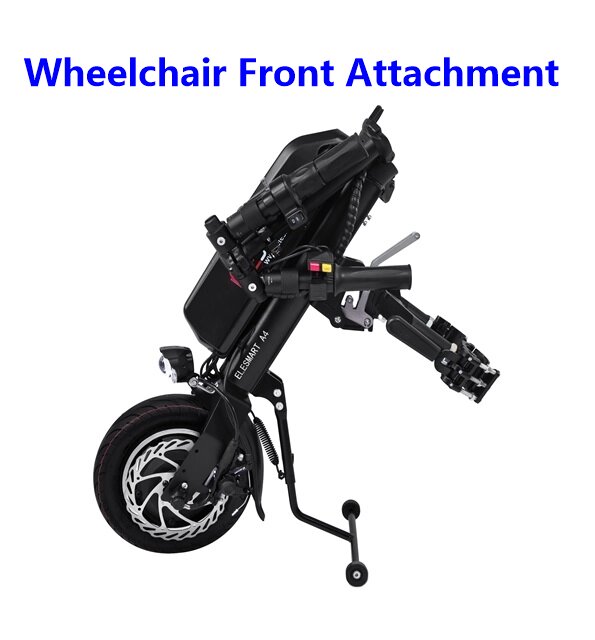
Mobility equipment has evolved dramatically over the past decade, and one of the most versatile categories to emerge is the wheelchair front attachment. Mounted to the front of a manual wheelchair, these devices add propulsion, stability, and terrain capability without requiring users to give up the chair they already know and trust. This guide explains what front attachments are, how they differ from other add-ons, the benefits they provide, and the factors to consider when selecting one.
A wheelchair front attachment is a detachable unit that connects to the front frame or footrest area of a manual wheelchair. It typically consists of one or two larger wheels, a mounting bracket, and—depending on the model—either a hand-crank drivetrain or an electric motor with battery. The attachment effectively replaces the small front casters during use, lifting them slightly off the ground and providing a smoother, more stable ride.
The core idea is modularity. A front attachment converts a manual wheelchair into a trike-like configuration for outdoor travel, then detaches quickly so the chair remains compact and maneuverable indoors or when folded for transport.
Buyers often encounter several related product categories, and understanding the differences helps in choosing wisely:
Front attachments mount at the front and typically provide a larger leading wheel, improved rolling efficiency, and either manual hand-crank or electric propulsion.
Rear power add-ons attach behind the chair and push it forward; they often preserve the front casters but add weight at the back.
Full electric wheelchairs replace the manual chair entirely, offering integrated power but generally less portability.
Handcycle attachments emphasize a cycling-style hand-crank experience, sometimes with motor assistance.
Front-mounted designs are particularly valued for their stability and natural steering feel, since the driven wheel leads the chair rather than pushing from behind.
1. Improved Terrain Handling
Small caster wheels struggle on gravel, grass, cracked pavement, and cobblestones. A larger front wheel rolls over obstacles far more easily, reducing the risk of the chair stopping abruptly or tipping.
2. Smoother, More Stable Ride
With the leading wheel carrying more of the load and absorbing bumps, users often report a noticeably smoother ride. The trike-like geometry also improves directional stability at speed.
3. Reduced Physical Strain
Whether hand-cranked or motorized, a front attachment reduces the repetitive pushing motion that stresses shoulders, wrists, and elbows. Over years of use, this can meaningfully protect joint health.
4. Extended Range and Confidence
Electric front attachments allow users to travel longer distances and tackle gentle slopes without exhaustion. This expands access to employment, education, shopping, and social activities.
5. Retained Portability
Because the unit detaches, users keep the folding, car-friendly nature of a manual wheelchair. This flexibility is a major advantage for people who alternate between indoor and outdoor environments.
6. Natural Steering Feel
Front-mounted propulsion pulls the chair rather than pushing it, which many users find intuitive and stable, especially when turning at low speed.
When comparing wheelchair front attachments, consider the following:
Propulsion type: Manual hand-crank for exercise and simplicity, electric for range and reduced effort, or a hybrid with variable assistance.
Motor power and battery capacity: Higher wattage suits hills and heavier loads; larger batteries extend range.
Wheel size and tire tread: Larger, treaded tires handle rough surfaces better.
Mounting system: Quick-release brackets simplify daily attachment and removal; verify compatibility with your wheelchair frame and footrest design.
Weight: A lighter unit is easier to lift, mount, and store.
Braking: Reliable brakes are essential on slopes; check whether braking is mechanical, electromagnetic, or disc-based.
Control ergonomics: Throttle, levers, and assistance controls should be reachable and intuitive.
Reverse function: Useful for maneuvering in tight spaces.
Weather resistance: Water-resistant components extend year-round usability.
Safety features: Lights, reflectors, and secure mounting reduce risk in low visibility.
Before purchasing, users should map out their typical journeys—distance, terrain, and frequency. A daily commuter will prioritize battery range and motor power, while an occasional user may value light weight and fast mounting. It is also important to confirm fit with the specific wheelchair model, and to check warranty terms, spare parts availability, and after-sales support.
Practice matters as well. New users should spend time in a safe, open area to become comfortable with acceleration, braking, and turning before heading into busy streets or uneven ground.
A front attachment is an investment in safety and daily independence, so expert guidance is valuable. An experienced manufacturer can advise on motor and battery specifications, mounting compatibility, and maintenance—ensuring the product matches the user's body, chair, and lifestyle.
Founded in 2011, ELESMART specializes in the development and production of wheelchair power attachments and electric handbikes. Backed by a technical team with decades of experience in the medical equipment industry, the company is driven by a mission to enhance mobility for individuals with disabilities and help them integrate fully into society. ELESMART maintains global local inventory distribution and is actively seeking global agents.
A wheelchair front attachment is a practical, flexible upgrade that improves stability, terrain capability, and range while preserving the portability of a manual wheelchair. It reduces physical strain and opens up outdoor environments that small casters cannot handle. By understanding the technology and choosing a reliable supplier, users can make a confident decision that supports a more active, independent life.
Contact us to find the right wheelchair front attachment for your needs.
Email: info@elesmart.com
Mobile: +86 13685249056


