
Views: 0 Author: Site Editor Publish Time: 2026-07-06 Origin: Site


For millions of manual wheelchair users worldwide, the daily reality of self-propulsion comes with hidden costs—chronic shoulder pain, crippling fatigue, and a world that often feels just out of reach. Studies show that more than 50% of long-term manual wheelchair users develop repetitive strain injuries, rotator cuff damage, carpal tunnel syndrome, or chronic pain. Slopes, thresholds, grass, gravel, and thick carpet can stop manual wheelchairs entirely. Most users can travel only 1–2 kilometers independently before exhaustion sets in.
The solution is not necessarily a new wheelchair—it's intelligent power assistance. Manual wheelchair power assist options have evolved dramatically in recent years, offering users a spectrum of choices that preserve the lightweight, foldable nature of their manual chairs while adding motorized support. Since 2023, China's "Rehabilitation Assistive Devices Catalogue" has officially classified these as "manual wheelchair add-on electric traction devices," recognizing their medical and daily value.
This guide explores the full range of manual wheelchair power assist options available today, helping you understand which solution best fits your lifestyle, mobility needs, and daily environment.
Manual wheelchair power assist options fall into several distinct categories, each with its own strengths, trade-offs, and ideal use cases. The three primary types are front-mounted power add-ons, rear-mounted power assist systems, and hub-mounted/wheel-replacement systems.
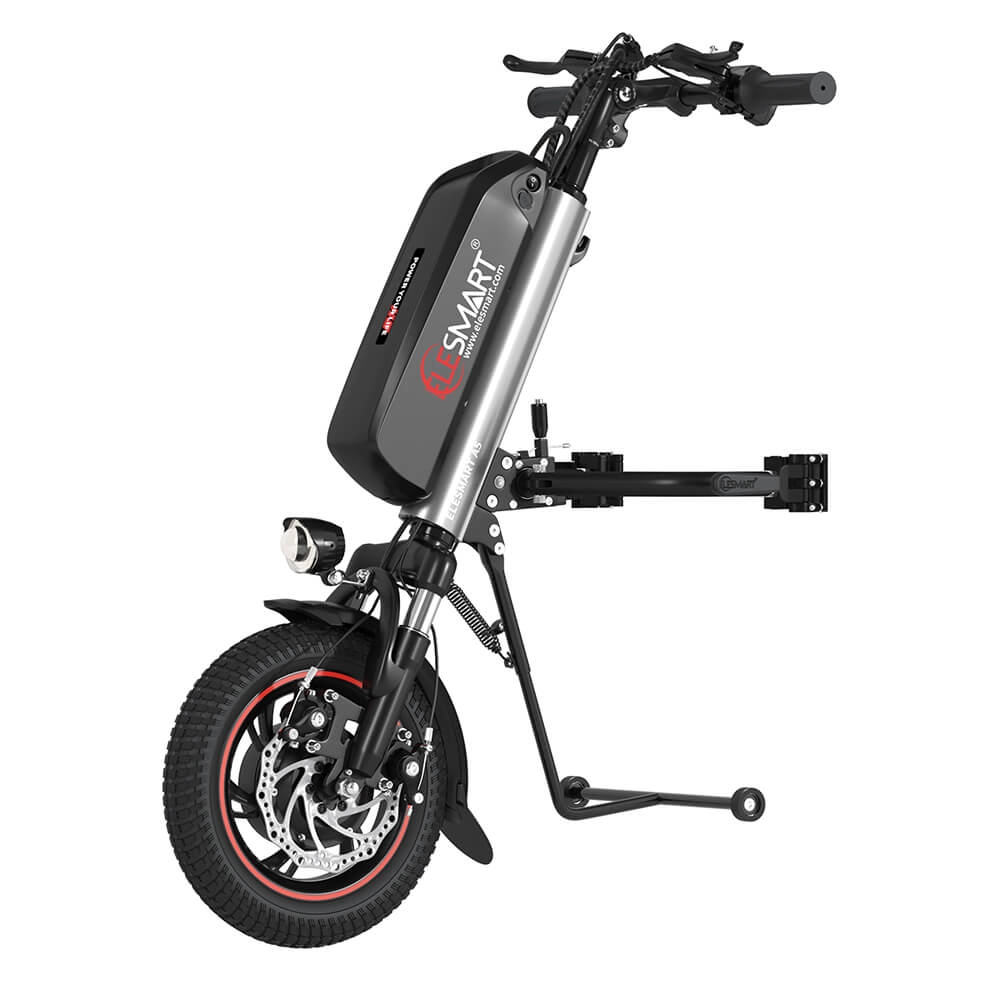
Front-mounted power add-ons—also known as electric handcycles or front-drive attachments—clip onto the front tubes, footplate, or frame of a manual wheelchair and convert it into a powered tricycle. These devices lift the front casters off the ground, turning a 4-wheel manual chair into a stable, 3-wheel electric ride.
This category represents one of the most popular and powerful manual wheelchair power assist options available today. Front-mounted systems offer:
Strong motor power: Typically ranging from 350W to 1000W
Long driving range: Up to 100 km on a single charge
Excellent outdoor performance: Superior handling on slopes, uneven terrain, and long distances
Detachable design: Easy to transport and store when not in use
ELESMART's front-mounted offerings include the A3, A5, A6, and A8 models. The A3 features a 36V 350W motor with 40Nm torque, reaching speeds up to 25 km/h with a range of up to 60 km. The A5 offers a 36V/48V 500W motor with a 12-inch tire, radius disc brake, and suspension fork for improved comfort. The A6 is equipped with a 36V/48V 500W geared motor producing 45Nm torque, saving 20% energy compared to gearless motors, with a range of 35-65 km. For maximum performance, the A8 delivers a 48V 1000W motor with 85Nm torque, 16-inch fat tires for challenging terrain, speeds up to 40 km/h, and an impressive range of 80-100 km.
Rear-mounted power assist systems attach to the back of the wheelchair frame and provide propulsion assistance by pushing from behind. These systems typically include a motorized drive unit that connects to the wheelchair's axle or frame.
Key characteristics include:
Lightweight and flexible: Often the lightest power assist option available
Easy removal: Can be detached quickly when not needed
Versatile control options: Some models offer push-activated assistance while others use wearable controllers
Minimal added size: Does not significantly increase the wheelchair's footprint
Rear-mounted systems are often preferred by users who want occasional power assistance without altering the fundamental feel of their manual wheelchair. However, they may be heavy for users with less strength if they need to remove the unit frequently.
Hub-mounted power assist systems integrate motors and batteries directly into the wheelchair's wheels. These systems either replace the existing rear wheels entirely or add motorized hubs to the existing wheel setup.
Key features include:
Seamless integration: The power assist feels like a natural extension of manual propulsion
Handrim-activated assistance: Motors engage only when force is directed through the handrims, allowing greater distance to be traveled with each push stroke
Preserves wheelchair dimensions: Does not add length or significantly alter the chair's footprint
Easy switching: Users can swap between powered and manual wheels as needed
Some wheel-replacement systems can increase the force applied to handrims by up to 4 times, reducing energy expenditure by as much as 45%.
One of the most significant differences between power assist options lies in their speed and range capabilities.
Front-mounted systems offer the greatest speed and range. With speeds reaching 25-40 km/h and ranges of 40-100 km, these systems match the performance of urban bicycles and e-scooters. This expands a user's daily radius to the entire city, enabling true "go-anytime" freedom.
Rear-mounted and hub-mounted systems typically offer more modest speeds (around 6-10 km/h) and shorter ranges (15-30 km), making them better suited for shorter trips and indoor-outdoor transitions.
The control experience varies significantly across manual wheelchair power assist options.
Front-mounted systems use handlebar controls that feel more like riding a bicycle or e-trike. Direct steering is instinctive—the body naturally leans and adjusts, offering a greater sense of fun and autonomy.
Hub-mounted systems often use handrim-activated assistance, where the motor engages only when the user pushes the handrims. This provides a more natural transition between manual and powered propulsion.
Rear-mounted systems may use joystick controls, wearable devices, or Bluetooth signals to start, accelerate, and stop.
Front-mounted systems excel outdoors but are less maneuverable indoors due to their added length. However, they detach quickly, allowing users to revert to a compact manual wheelchair for indoor navigation.
Rear-mounted and hub-mounted systems maintain the wheelchair's original dimensions, making them more suitable for indoor use and tight spaces.
Front-mounted systems are detachable and can be stored separately from the wheelchair. Both the manual wheelchair (folded) and the power add-on can fit easily into a car trunk.
Hub-mounted systems require removing and replacing wheels, which can be heavy and cumbersome for users with limited strength.
Rear-mounted systems are generally lightweight and easy to remove.
Daily commuters who travel longer distances regularly
Outdoor enthusiasts who want to explore parks, trails, and urban environments
Users who prioritize speed and range over indoor maneuverability
Those who want the "Transformer" experience: a compact manual chair indoors and a powerful electric vehicle outdoors
Users who need occasional power assistance rather than full-time electric propulsion
Individuals who primarily navigate indoor environments but need help with slopes or longer corridors
Users who want to preserve the exact feel of their manual wheelchair
Those who travel frequently and need lightweight, easily transportable solutions
For many users, manual wheelchair power assist options offer distinct advantages over purchasing a full electric wheelchair:
Ultimate Flexibility: At home, use a lightweight, narrow manual wheelchair that moves effortlessly through indoor spaces. Out and about, attach the power assist and transform into an electric mobility vehicle.
Speed and Range Revolution: Electric wheelchairs travel at roughly 6 km/h (brisk walking speed), confining users to their neighborhood. Power assist options reach 25-40 km/h with 40-100 km range, matching urban bicycles and expanding daily radius to the entire city.
Superior Control Experience: Electric wheelchairs feel like operating equipment with a joystick. Power assist options with handlebar controls feel like riding—instinctive, engaging, and fun.
Travel Convenience: Full electric wheelchairs are often prohibited on buses, trains, and taxis. With a power assist, you can fold the manual wheelchair, detach the power unit, and fit everything into a car trunk.
Cost-Effectiveness: Power assist options are significantly more affordable than purchasing a new electric wheelchair, while preserving the wheelchair you're already comfortable with.
When evaluating manual wheelchair power assist options, consider these essential features:
Motor Performance: Look for models with sufficient torque (40-85Nm) to tackle slopes of 8-10 degrees. Geared motors are typically 20% more energy-efficient than gearless motors.
Battery and Range: Lithium battery options range from 7.8Ah to 20Ah, offering ranges from 35km to 100km. Consider removable batteries for easy charging and, in some cases, air travel compatibility.
Compatibility: Ensure the power assist fits your wheelchair. Many front-mounted systems fit wheelchair tubes with dimensions between 22mm and 32mm.
Safety Features: Look for disc brake systems, shock absorption, LED front lights, reverse speed limits, and CE certification.
Ease of Installation: The best options come with 99% of components pre-assembled and require no special tools for installation.
The market for manual wheelchair power assist options is growing rapidly as technology improves and awareness increases. Battery technology continues to advance, offering greater range with less weight. Motor efficiency improves with each generation. And the range of available options expands, ensuring there's a solution for every user's unique needs.
As one ELESMART employee and wheelchair user shared, after installing a power assist device, he was able to overcome the bulkiness of traditional electric wheelchairs and the difficulty of climbing inclines with manual wheelchairs. He can now travel smoothly on subways in multiple cities, truly achieving the freedom to "go wherever he wants".
Choosing among manual wheelchair power assist options ultimately comes down to understanding your daily needs:
How far do you travel regularly? Longer distances favor front-mounted systems.
Where do you travel? Indoor-heavy use favors rear-mounted or hub-mounted systems.
How much upper body strength do you have? Consider the weight of removal and installation.
What's your budget? Front-mounted systems offer more power and range at a higher price point.
Do you travel with your wheelchair? Portability favors detachable front-mounted or lightweight rear-mounted systems.
Ready to explore the right manual wheelchair power assist option for your needs?
Contact Elesmart today to learn more:
Email: info@elesmart.com
Mobile: +86 13685249056
Take the first step toward greater independence, less fatigue, and a world without limits—your journey starts now.


